
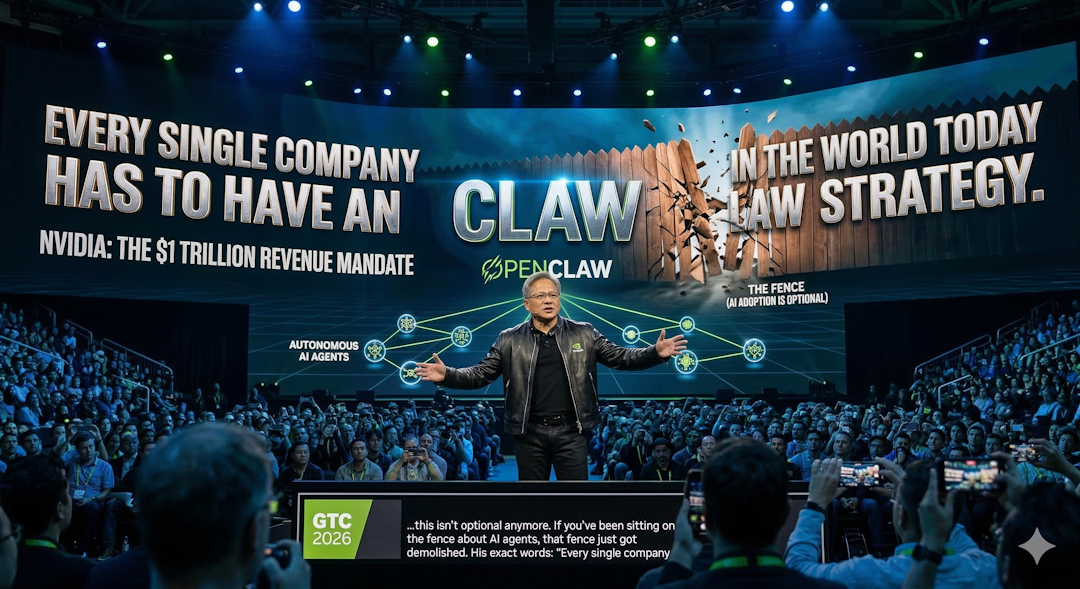
The world watched Jensen Huang walk onto the stage at the SAP Center in San Jose and tell every company on the planet that they need an OpenClaw strategy. Not “should consider.” Not “might want to explore.” His exact words: “Every single company in the world today has to have an OpenClaw strategy.” That’s the CEO of a company projecting $1 trillion in revenue telling you this isn’t optional anymore. If you’ve been sitting on the fence about AI agents, that fence just got demolished.
I’ve been running OpenClaw on my Mac Mini for months now. I’ve written about it extensively on this blog. I’ve seen what it can do. I’ve also seen what can go wrong. So when Jensen Huang dedicated a significant chunk of his GTC 2026 keynote to OpenClaw and unveiled NemoClaw, NVIDIA’s enterprise stack built on top of it, I knew this was the moment everything changed. Today I’m breaking down exactly what happened, why it matters, and what you need to do about it.
What Jensen Actually Said
Let’s get into the specifics of what Huang said on stage today, because the exact language matters here.
He called OpenClaw “the operating system for personal AI.” Think about that framing. Not a tool. Not an app. An operating system. He’s positioning OpenClaw at the same level as Windows, Linux, or macOS, but for AI agents instead of human users.
Then he went further. He called it “the most popular open source project in the history of humanity.” That’s a bold claim, but the numbers back it up. OpenClaw crossed 250,000 GitHub stars and surpassed React, and it did it in roughly 60 days. Nothing in open source history has moved that fast.
He spotlighted Peter Steinberger, the Austrian developer who created OpenClaw and recently joined OpenAI. He compared OpenClaw’s importance to HTML and Linux. Not to some niche developer tool. To HTML. The thing that made the web possible. To Linux. The thing that runs most of the internet’s infrastructure.
And then came the big announcement. NVIDIA unveiled NemoClaw, their enterprise-grade stack for OpenClaw, paired with OpenShell, a secure runtime for AI agents. Jensen said NemoClaw plus OpenShell can be “the policy engine of all the SaaS companies in the world.”
NVIDIA also announced full platform support for OpenClaw across their ecosystem. This wasn’t a passing mention. This was a strategic commitment from the most valuable technology company on earth.
The rest of the keynote was packed too. The Vera Rubin platform for full-stack agentic AI computing. DLSS 5. A Disney robotics partnership. The Feynman architecture preview. Space-1, which is literally AI data centers in orbit. Jensen also touted the Nemotron Coalition, NVIDIA’s expanded open model ecosystem designed to power the next generation of AI agents. But the OpenClaw segment? That’s the one that’s going to change how enterprises operate in 2026 and beyond.
And I want to be clear about something. This wasn’t a throwaway mention. Jensen didn’t casually name-drop OpenClaw in a list of cool technologies. He built an entire narrative arc around it. He positioned it as infrastructure. He announced a product built specifically for it. He brought its creator on stage. When the CEO of NVIDIA gives something that kind of treatment at GTC, the industry listens.
Why This Is an Inflection Point
Here’s the thing. Six months ago, OpenClaw was the hottest tool in tech. Developers loved it. Power users were building incredible workflows with it. I was using it to run my business. But enterprises? They were terrified of it.
And honestly, they had good reason to be terrified.
OpenClaw runs with your full user privileges. It has access to your disk, your terminal, your network. It’s incredibly powerful, and that power comes with real risk. Companies were banning it left and right. Security teams were issuing advisories. The tool that developers couldn’t stop talking about was the same tool that CISOs couldn’t stop worrying about.
That tension, the gap between “this is amazing” and “this is dangerous,” is exactly what NVIDIA just stepped in to solve. And the timing isn’t accidental. When Jensen Huang compares something to HTML and Linux, he’s not being hyperbolic. He’s signaling that NVIDIA is going to treat OpenClaw as foundational infrastructure. And when NVIDIA treats something as foundational, the entire industry follows.
OpenClaw went from 0 to 250,000 GitHub stars faster than any project in history. It’s already being compared to cloud-hosted alternatives like Perplexity Computer and Claude Cowork.
The AI agent space is clearly splitting into two camps. On one side, you have managed cloud solutions that are polished, secure by design, and abstract away the complexity. On the other side, you have the self-hosted open-source approach that OpenClaw represents. More power, more flexibility, more control, but historically more risk.
Today, NVIDIA just put its full weight behind the self-hosted camp. And by building NemoClaw’s enterprise security layer, they’ve neutralized the primary argument against open-source AI agents. That changes the calculus for every enterprise decision-maker reading this.
The Security Problem That Almost Derailed Everything
Before I explain what NemoClaw does, you need to understand the problem it’s solving. Because this context is critical. And if you’re someone who’s been following the OpenClaw story, you know it hasn’t been a smooth ride.
In early 2026, the security situation around OpenClaw got ugly. Really ugly.
CVE-2026-25253 was a one-click remote code execution vulnerability. One click. That’s all it took for an attacker to execute arbitrary code on your machine through OpenClaw. For a tool that already has full system access, that’s a nightmare scenario.
Then came the plugin problem. Security researchers found that 10.8% of ClawHub plugins were malicious. Think about that. Roughly one in ten plugins on the official marketplace was designed to harm you. Not buggy. Not poorly written. Malicious.
The corporate response was swift and brutal.
Google banned paying subscribers from using OpenClaw. Meta prohibited it on all work devices. CrowdStrike and Cisco issued advisories calling OpenClaw a “significant security risk.” Several banks and government bodies restricted access. Chinese authorities moved to restrict state-run enterprises from running it. One security expert called it “the biggest insider threat of 2026.” Gartner analysts estimated that migration costs would run into several million dollars for large banks that needed to unwind their OpenClaw deployments.
Let that sink in. The most popular open source project in history was getting banned by some of the biggest companies in the world. The enterprise AI tool strategy conversation shifted from “how do we adopt this” to “how do we contain this.”
And a court ruling in March 2026 from Judge Chesney in the Northern District of California added another wrinkle. The ruling established that user authorization doesn’t override platform rules for AI agents. So even if you gave OpenClaw permission to do something, the platform you’re interacting with can say no. That has massive implications for how agentic tool calling works in practice.
This is the world that Jensen Huang walked into today. And this is why NemoClaw matters so much.
Think about it this way. The most transformative open source tool in years was becoming untouchable for the very organizations that would benefit from it most. Enterprise IT leaders were caught between developers who loved it and security teams who feared it. Something had to give. Either OpenClaw would become secure enough for enterprise use, or it would remain a shadow IT problem forever. NVIDIA just chose option one and threw billions of dollars of platform support behind that choice.
NemoClaw + OpenShell: What They Actually Do
So what did NVIDIA actually build? Let me break it down in plain terms.
NemoClaw: The Enterprise Wrapper
NemoClaw is an open-source AI agent platform designed specifically for enterprises. Think of it as a security and governance layer that wraps around OpenClaw, adding everything that was missing for corporate adoption.
Here’s what it includes:
Audit logs. Every action your AI agent takes gets logged. Every file it reads, every command it runs, every API call it makes. You can trace exactly what happened and when. For compliance teams, this is huge.
Permission controls. Instead of OpenClaw’s current model where the agent has your full privileges, NemoClaw lets you define exactly what an agent can and can’t do. Read this folder but not that one. Access this API but not that one. Run commands in this directory but nowhere else.
Compliance tools. Built-in support for the kinds of compliance requirements that enterprises deal with daily. Data residency rules. Access controls. Regulatory reporting.
Multi-agent collaboration. NemoClaw supports supervisor and worker agent patterns. You can have a supervisor agent that oversees and coordinates multiple worker agents, each with their own permission boundaries. This is how complex enterprise workflows will actually get built.
One-command install for existing OpenClaw users. If you’re already running OpenClaw (and I’ve written a full setup guide if you’re not), adding NemoClaw is a single command. NVIDIA made the on-ramp as frictionless as possible. No rip-and-replace. No complex migration. Just layer NemoClaw on top of what you already have. That’s exactly the right approach for driving adoption.
And here’s the detail that surprised me most: NemoClaw is hardware agnostic. It works on NVIDIA GPUs, obviously, but also on AMD, Intel, and even CPU-only setups. NVIDIA could have locked this to their hardware. They didn’t. That tells you they’re playing the ecosystem game, not the hardware lock-in game.
OpenShell: The Security Foundation
OpenShell is the runtime layer underneath NemoClaw, and it’s where the real security innovation lives.
Process-level isolation. Each AI agent runs in its own sandbox, isolated from the rest of your system. Even if an agent gets compromised, the blast radius is contained.
Zero permissions by default. This is the opposite of how OpenClaw works today. Right now, OpenClaw starts with access to everything. OpenShell flips that. Agents start with access to nothing and must be explicitly granted each permission. That’s a fundamental security architecture change.
Privacy router. OpenShell includes a data exposure control layer that manages what data flows where. If an agent doesn’t need access to your financial data to complete a task, the privacy router ensures it never sees that data in the first place.
Network guardrails. Controls over what network resources an agent can access. No more worrying about an agent making unauthorized API calls or exfiltrating data to unknown endpoints. For organizations that deal with sensitive data (financial services, healthcare, government), this is the feature that moves OpenClaw from “absolutely not” to “let’s talk.”
Policy enforcement at the infrastructure level. This is what Jensen meant when he said NemoClaw plus OpenShell can be “the policy engine of all the SaaS companies in the world.” The policies aren’t suggestions. They’re enforced at the runtime level. An agent literally can’t violate them.
If you’ve been troubleshooting OpenClaw issues or worrying about security gaps in your setup, NemoClaw and OpenShell are the answers you’ve been waiting for.
The Enterprise Partners Lining Up
Here’s where it gets really interesting. NVIDIA isn’t doing this alone.
The enterprise partners already being courted for NemoClaw include Salesforce, Cisco, Google, Adobe, and CrowdStrike. Read that list again. Cisco and CrowdStrike, the same companies that issued security advisories calling OpenClaw a “significant security risk,” are now partnering with NVIDIA on the enterprise version.
That’s not a contradiction. That’s validation. Those companies understand the technology’s potential better than anyone because they spent months analyzing its risks. Now that NVIDIA has built a security layer they can trust, they’re jumping in.
The major partnerships are expected to go live Q2 through Q3 of 2026. That means by summer, you’ll likely see NemoClaw integrations showing up in Salesforce workflows, Cisco security dashboards, and CrowdStrike threat monitoring tools.
The enterprise AI agent market is projected to hit $28 billion by 2027. Huang mentioned that $150 billion was invested in AI startups last year alone. The money is flowing, and it’s flowing toward exactly the kind of infrastructure that NemoClaw represents.
This isn’t just about OpenClaw anymore. This is about who controls the enterprise AI agent stack. And right now, NVIDIA is making an aggressive play to be that foundation layer.
Here’s the thing. NVIDIA has a playbook for this. They did it with CUDA for GPU computing. They did it with cuDNN for deep learning. They identify the foundational layer, build the tools to make it enterprise-ready, and then partner with the biggest players to drive adoption. It worked spectacularly before. And with $150 billion flowing into AI startups last year alone (a number Jensen cited in the keynote), the stakes for getting the agent infrastructure right are enormous.
The fact that the NVIDIA Agent Toolkit simplifies installation for enterprises is another signal. They want to remove every friction point. They want the path from “we’re evaluating AI agents” to “we’re running agents in production” to be as short as possible. When a company like NVIDIA makes something easy, adoption follows. Fast.
What This Means for Different Audiences
I know my readers come from different backgrounds, so let me break down what today’s announcement means depending on where you sit.
For Enterprise IT Leaders
You need to start evaluating NemoClaw now. Not next quarter. Now.
If your organization has already banned or restricted OpenClaw, today’s announcement gives you a path to reconsider. The security objections that drove those bans are exactly what NemoClaw was designed to address. Schedule a briefing with your security team. Show them the OpenShell architecture. Zero-permissions-by-default and process-level isolation are the kinds of security primitives that should make your CISO significantly more comfortable.
If your organization is already using OpenClaw informally (and trust me, your developers are using it whether IT approved it or not), you need to get ahead of this. Audit your existing OpenClaw deployments. Understand what agents are running, what they have access to, and what data they’re touching. Then plan your migration to NemoClaw.
For Developers
Learn OpenShell. Seriously. If NemoClaw becomes the standard enterprise AI agent platform, and NVIDIA is betting hard that it will, then developers who understand OpenShell’s permission model and policy enforcement will be in massive demand.
Start building agents that are designed for zero-permissions-by-default environments. The agents that win in enterprise settings won’t be the ones that need access to everything. They’ll be the ones that work gracefully within tight permission boundaries.
If you haven’t already, get comfortable with how AI agents actually think and make tool calls. Understanding agentic architecture is becoming a career-defining skill.
For Business Owners and SMBs
Don’t panic. You don’t need to implement NemoClaw tomorrow.
Here’s what I’d recommend. If you’re not using OpenClaw at all yet, start with the basics. Get it set up. I wrote a complete guide for running it on a Mac Mini that walks you through everything. Understand what AI agents can do for your workflows before you worry about enterprise governance.
If you’re already using OpenClaw, keep an eye on NemoClaw as it rolls out in Q2. For SMBs, the one-command install path means you can add enterprise-grade security without enterprise-grade complexity. That’s a real advantage.
The real cost of AI agents is still a factor, but the ROI picture just got a lot clearer. When NVIDIA says every company needs an OpenClaw strategy, that includes companies your size.
For Individual Professionals
Your career just got a new dimension. AI agent management, governance, and security are about to become their own specialty. The professionals who understand how to deploy, configure, and manage NemoClaw in enterprise environments will have skills that didn’t exist six months ago but will be critical six months from now.
Start learning. Start experimenting. The gap between “I know what OpenClaw is” and “I can deploy and manage NemoClaw in an enterprise environment” is where the career opportunities are going to be.
And consider this. OpenClaw already has 50+ integrations and a massive plugin ecosystem. The professionals who understand that ecosystem, who know which integrations work well and which ones have security concerns, who can architect multi-agent workflows within NemoClaw’s governance framework, those people are going to be invaluable. This is a new career path that’s forming right now, in real time, as you read this post.
My Perspective as an OpenClaw User
I want to share something personal here. I’ve been running OpenClaw daily for months. It’s woven into how I run my business. I use it for content research, workflow automation, and a dozen other things I’ve written about on this blog.
And I’ve felt the security tension firsthand.
Every time I read about CVE-2026-25253, I checked my own setup. When reports came out about malicious plugins on ClawHub, I audited every plugin I had installed. When companies started banning OpenClaw, I understood why, even as I kept using it because the productivity gains were too significant to give up.
That’s the dilemma that millions of OpenClaw users have been living with. You know the tool is powerful. You know it makes you better at your job. But you also know it has your full system access and the security model isn’t where it needs to be.
NemoClaw solves that dilemma. And I don’t say that lightly. I’ve compared nearly every major AI agent platform on the market, and the security gap has always been OpenClaw’s biggest weakness for serious production use. The zero-permissions-by-default model in OpenShell is exactly what I’ve been wanting. The audit logs mean I can actually verify what’s happening in my workflows. The policy enforcement means I can set boundaries and trust that they’ll hold.
When I compared OpenClaw to alternatives like GPT-5.4 and Claude Cowork, one of the trade-offs was always security versus flexibility. NemoClaw changes that trade-off equation entirely.
Your OpenClaw Strategy Playbook for Q2 2026
Jensen said every company needs an OpenClaw strategy. So here’s your actual playbook. Concrete steps you can take starting this week.
Step 1: Assess Your Current State
Do you have OpenClaw deployed anywhere in your organization? Formally or informally? Find out. Survey your development teams. Check your endpoint management tools. You might be surprised at how many people are already using it.
Step 2: Audit Existing Deployments
For every OpenClaw instance you find, document what it has access to. What files can it read? What APIs can it call? What commands can it execute? What credentials does it have access to? This is your risk baseline. And given the CVE and malicious plugin history, this step isn’t optional. You need to know what you’re working with before you can improve it.
Step 3: Evaluate NemoClaw
When NemoClaw becomes available for your environment (NVIDIA is rolling it out post-GTC with major partnerships going live Q2 through Q3), run a pilot. Start with a non-critical workflow. Test the permission model. Test the audit logging. Test the policy enforcement. Understand how it works before you roll it out broadly.
Step 4: Define Your Agent Governance Framework
Before you deploy agents at scale, you need governance. Who can create agents? What permissions can they grant? How are agents audited? Who reviews the logs? NemoClaw gives you the tools for governance, but you need to define the policies that those tools enforce.
Step 5: Train Your Teams
This is the step most organizations will skip, and it’s the step that matters most. Your developers need to understand how to build agents for zero-permissions environments. Your IT teams need to understand how to manage NemoClaw. Your business users need to understand what agents can do for them and what the boundaries are.
Step 6: Start Small and Expand
Pick one workflow. Automate it with an OpenClaw agent running under NemoClaw’s governance. Measure the results. Learn from the experience. Then pick another workflow. And another. Build momentum gradually instead of trying to transform everything at once.
If you need help getting OpenClaw set up in the first place, my troubleshooting guide covers the most common issues people run into.
The bottom line? Don’t try to boil the ocean. Jensen Huang said every company needs an OpenClaw strategy. He didn’t say every company needs to transform overnight. Strategy means having a plan. Having a direction. Knowing where you’re going even if you’re not there yet. Start building that plan today, and execute it thoughtfully over the next two quarters.
Your Turn To Share
I watched Jensen Huang’s keynote this morning and immediately started writing this because I think it’s that important. The CEO of NVIDIA just told every company in the world that they need an OpenClaw strategy. Whether you agree with that or think it’s premature, the conversation has shifted.
So here’s my question for you. Does your company have an OpenClaw strategy? Are you using it already? Considering NemoClaw? Or are you still in the “wait and see” camp? I’d love to hear where you stand and what your biggest concern is about bringing AI agents into your organization. Drop a comment below or reach out to me directly. This conversation is just getting started.