
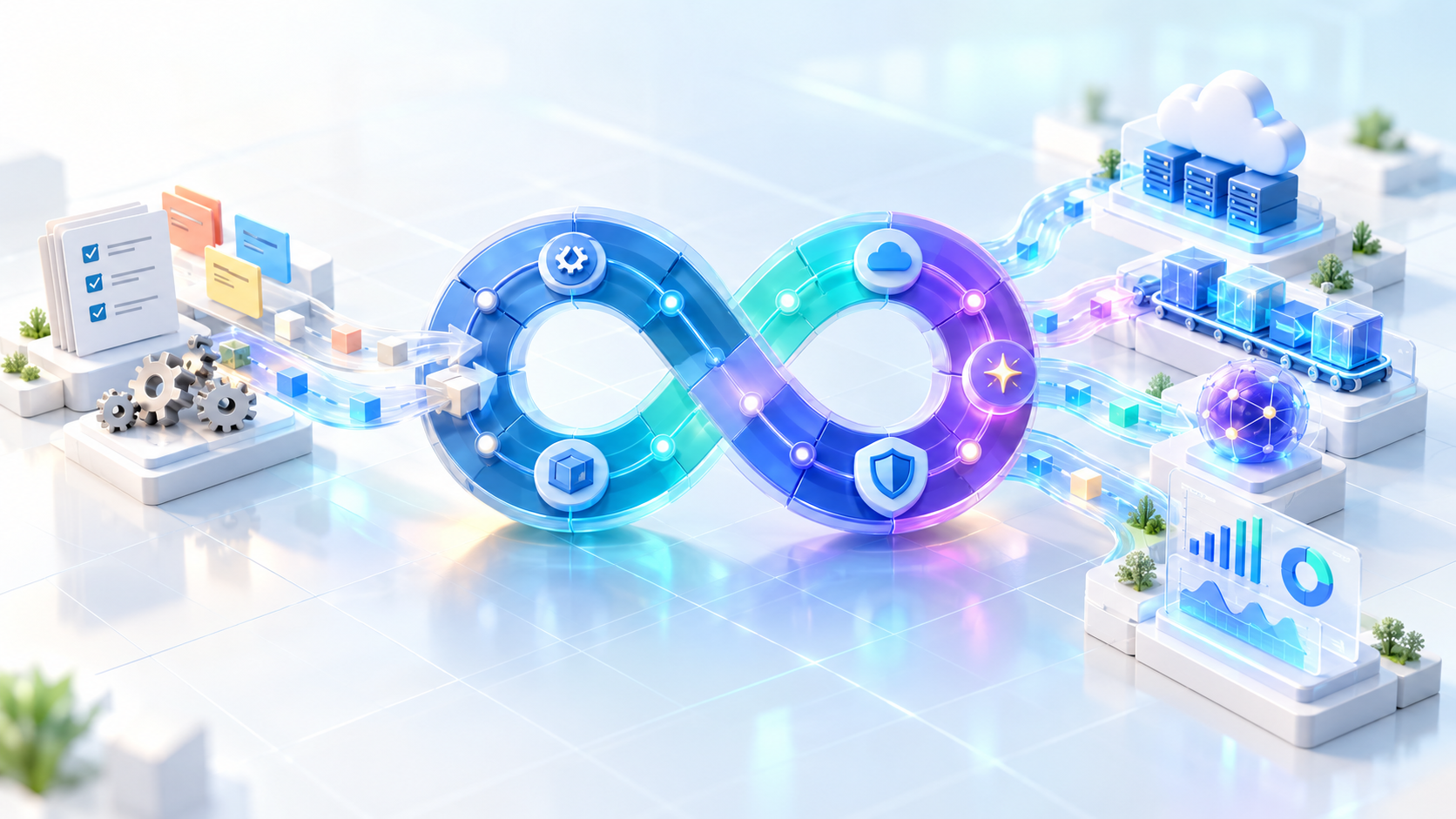
Enterprises can now no longer depend on manual, slow processes to deliver software and services. The shift towards intelligent automation connects development and operations to let organizations work more efficiently and respond quickly to changes. This shift is the Enterprise DevOps transformation. The transformation focuses on promoting unified workflows, decreasing repetitive tasks, and empowering teams to build innovative solutions. AI-based practices and automation are now important for enterprises that aim to stay competitive, resilient, and secure. This blog discusses the need for the Enterprise DevOps transformation, stages involved in the process, trends, best practices, and more.
Manual Processes vs. Intelligent Automation
In this digital first world, the differences between these two are important to understand in enterprise DevOps. They are explained below.
Understanding manual processes
In DevOps, manual processes involve people carrying out repetitive tasks like code deployment, testing, etc. Such tasks usually need judgment but are prone to delays, human error, and limits (in terms of scalability). Let’s have an example to understand better. Manual data entry can make release cycles slower. Recent studies indicate that manual workflows can add to inefficiencies, raise error rates, and thus make enterprises dependent on individuals.
Ways in which Intelligent Automation brings changes
Intelligent automation combines two important aspects: AI-powered insights and rule-based automation. It does not rely on humans to carry out repetitive tasks but instead uses automated pipelines. These pipelines manage tasks like deployments, testing, and monitoring. All these tasks are managed well without compromising consistency and speed.
The involvement of AI helps spot risks, self-heal infrastructure, and automatically ensures compliance. The shift to intelligent automation is valuable for tasks that are frequent and prone to errors, but cannot compromise on consistency.
To help enterprises ensure more reliable delivery, intelligent automation promises low downtime, high scalability, and better security.
Understanding Enterprise DevOps Transformation
The term Enterprise DevOps transformation refers to the shift from isolated operations, development, and security teams to a unified system. In this unified system, each team owns its service end to end. This means that the infrastructure is managed as code, and the improvements are continuous to let enterprises deliver faster and more reliable results.
Various modern DevOps practices it adopts are continuous integration and delivery, automated testing, infrastructure as code, and observability. In startups, DevOps usually grows organically. But enterprises struggle with aspects like strict compliance requirements, isolated teams, and legacy systems.
The transformation here suggests focus on reforming processes, culture, and governance to guarantee agility yet not compromise on reliability.
The shift is not just technical. It also focuses on uniting processes, people, and technology across large teams.
Need for the Transformation
Let’s now understand why this transformation matters.
- Manual processes slow innovation. Enterprises need to deliver updates quickly so as to stay competitive.
- With automated pipelines and monitoring, downtime reduces and recovery speed increases.
- Intelligent automation integrates regulatory and security audits directly within workflows to decrease risk.
- The transformation unites teams with shared responsibility.
Stages Involved in the Enterprise DevOps Transformation
The stages described below help enterprises stay resilient, agile, and compliant at scale.
Stage 1: Analyzing the current processes
The transformation first focuses on understanding the existing state of enterprise systems and then aligning DevOps objectives with business objectives. First, the team assesses legacy infrastructure, compliance needs, and current workflows. This is a kind of planning stage that works on identifying gaps, defining outcomes, and uniting teams. If the planning is poor, it can lead to errors and delays. Without this first stage, there is a risk of fragmented pipelines in enterprise DevOps and resources are wasted.
Stage 2: Building scalable infrastructure
After the strategy becomes clear, enterprises shift their focus to platform engineering. They work on building scalable foundations with Infrastructure as Code (IaC). It involves provisioning networks, servers, and environments through code instead of performing manual configuration.
IaC promises consistency, decreases human error, and facilitates swift scaling across environments. For enterprises that modernize legacy systems, platform engineering is critical. The reason is that it provides a standardized foundation for automation. This stage makes infrastructure a flexible, automated resource that supports DevOps workflows.
Stage 3: Implementation of CI/CD pipelines
The third stage is all about automating delivery pipelines. CI/CD makes sure every code modification is automatically created, tested, and deployed. This can be understood as the shift from code to build to test to release and finally to deployment (all these in a continuous loop. The implementation of these pipelines leads to automatic testing, integration, and deployment. So, it improves reliability and decreases delays.
This is the core stage that enables enterprises to embrace innovation. In this stage, manual bottlenecks are overcome with intelligent automation to ensure consistency and speed.
Stage 4: DevSecOps Integration
It is essential to embed security early. DevSecOps integrates security checks into all stages of the pipeline. Tasks like automatic scanning for vulnerabilities, validating compliance, and enforcing policy make sure enterprises follow regulatory requirements without slowing down delivery.
The integration of security into DevOps workflows decreases risk and improves resilience. It is vital to automate governance and compliance for enterprises that deal with sensitive data. This stage keeps agility safe, and thus makes DevOps sustainable in fields like healthcare and finance.
Stage 5: Visibility and monitoring
After implementing security and automation, enterprises need real-time insights into system performance, health, and user behaviour. Monitoring is the last part of the DevOps loop. It feeds back data into planning and coding. Enterprises use observability tools to track logs, metrics, and traces. Hence, issues are resolved proactively.
Intelligent automation applies predictive analytics to let systems heal automatically and avoid failures. In this stage, DevOps evolves from reactive fixes to resilience. So, enterprises get visibility across complex environments so they can keep customers satisfied and ensure reliability.
Stage 6: Automating governance and compliance
Enterprises work under strict regulatory standards. Manual audits are error-prone and slow. Automating governance means compliance checks are directly integrated into pipelines. This makes sure every release fulfils regulatory standards. Also, it protects enterprises from expensive unplanned downtime. Automated governance decreases risk, builds trust, and makes sure enterprises can innovate without paying regulatory fines.
Stage 7: Scaling through continuous improvement
DevOps is an ongoing journey, not a one-time project. Feedback loops coming from user behaviour, monitoring, and business outcomes are fed into planning. In this stage, enterprises improve pipelines, use new tools, and scale automation across teams. Also, this stage prepares enterprises to adopt new technologies like hybrid cloud and AIOps. Enterprises stay agile, future-ready, and competitive.
Tools Helpful for the Transformation
The transformation process depends on the use of a set of tools that automate, secure, and scale software delivery. The essential tools for the same are discussed here.
1) CI/CD platforms
- GitHub Enterprise Cloud: It combines multiple facets like source control, Codespaces (for cloud development), GitHub Actions (for CI/CD), and advanced security features. It is broadly used to help enterprises scale and work more productively.
- GitLab Ultimate: It is a comprehensive DevSecOps platform. It integrates source control, CI/CD, compliance management, etc. It is a perfect choice for enterprises looking for a unified integrated solution.
- Azure DevOps services: They deeply integrate into the Microsoft ecosystem. It provides repos, pipelines, boards, and artifacts. Enterprises that deal with Azure and .NET workloads will find these services useful.
- Jenkins: If enterprises work in a highly regulated environment, then Jenkins is a suitable platform. It ensures full control.
2) Infrastructure as Code (IaC)
These tools automate configuration (with code) to ensure scalability and consistency.
- Terraform Enterprise/OpenTofu: It is proven for managing infrastructure across cloud providers. It is backed by Sentinel for policy compliance.
- Pulumi: It is an IaC tool that uses familiar programming languages that developers can easily understand.
- Ansible: It is a configuration management tool used to automate application deployment and server setup.
3) Containers and Orchestration
These tools provide scalability, portability, and resilience across environments.
- Docker: It is used to package apps into containers for easy development.
- Kubernetes: This is an enterprise-grade tool used to manage containers at scale.
- Amazon ECS: It is an orchestration service for AWS-based enterprises.
4) GitOps & Internal Developer Platforms
- ArgoCD and Flux: These are GitOps tools for Kubernetes. They allow deployments to be managed through code and version control.
- Backstage (open-source), Port, and Humanitec: These tools unify developer tools to make platform engineering more effective and smoother.
5) Security and Compliance
The following tools directly integrate security into pipelines to ensure compliance with relevant regulatory standards.
- 8Sny: Helps developers find and solve security issues in open-source code.
- HashiCorp Vault: It allows secure storage and management of keys, passwords, and other sensitive info.
- Trivy: It scans containers and applications to identify security vulnerabilities.
- JFrog Xray: It identifies dependency issues, security risks, and license compliance issues in software components.
6) Monitoring
These tools help resolve issues proactively and maintain system reliability.
- Prometheus + Grafana: These open-source tools are used to monitor system performance and visualize data.
- Datado: It offers AI insights into the system’s health.
- gNew Relic: It is a monitoring tool that tracks and improves application performance.
7) Testing
- Cypress: Useful for end-to-end testing.
- Playwright: Helps with cross-browser testing.
- SonarQube: Used to check code quality and perform security analysis.
- k6: Used for load testing to validate performance.
8) Governance
With these tools, enterprises can support compliance and maintain governance at scale.
- Open Policy Agent (OPA): It automates policies and compliance checks.
- Kyverno: It manages and implements policies in Kubernetes environments.
- Infracost: It helps estimate cloud costs and enhances cost management.
Best Practices
Enterprises can follow any of these practices to ensure a smooth and reliable DevOps transformation.
1) Promote a collaborative culture
It is not just tools but also people involved in the transformation. Enterprises should eliminate barriers between operations, development, QA, and security teams. To successfully adopt DevOps, enterprises must focus on cross-functional collaboration and shared responsibility. A culture that is transparent, with clear communication, and fosters continuous learning can ensure automation becomes successful.
2) Begin small and proceed gradually
Many large enterprises fail when they try for massive transformation. It is recommended to start small. Automate one pipeline, upgrade one legacy system, or pilot DevSecOps in a single team. Enterprises can then scale across the organization.
With incremental change, there is less risk and more confidence. Teams can learn from early successes. This practice makes sure transformation is sustainable.
3) Prioritization
Enterprises need to learn how to prioritize automation in high-impact areas. The automation must begin where manual processes create more issues. For example, it can begin with deployments and testing. Subsequently, it can focus on governance and monitoring.
4) Implement security early
It’s all about DevSecOps, which suggests embedding security early. It is best to integrate compliance validation, automated vulnerability scanning, and policies early into pipelines directly. This practice reduces risk and speeds up delivery as it avoids expensive changes later on.
5) Use of the right metrics
Metrics such as lead time for changes, change failure rate, etc., are known as benchmarks for the success of DevOps. Enterprises need to continuously track these metrics to detect issues and measure progress. Observability tools must provide feedback into the planning phase.
6) Focus on platform engineering
Developers who invest in platform engineering benefit from standardized environments, self-service capabilities, and automated infrastructure. The relevant tools, for example, Terraform, allow enterprises to consistently scale DevOps practices. With platform engineering, developers can focus on innovation instead of managing infrastructure.
7) Continuous improvement
Since DevOps is an ongoing journey, enterprises should set up feedback loops, experiment with new changes, and invest in training. This practice keeps enterprises competitive as technologies like hybrid cloud and AIOps develop.
Trends to see in Enterprise DevOps
Here are some key trends we can watch in terms of the enterprise DevOps shift.
1) Prevalence of AIOps
AIOps which stands for Artificial Intelligence for IT Operations is getting central to enterprise DevOps. Enterprises can apply machine learning to metrics, logs, and events. This approach helps them estimate failures, automate analysis of root causes, and activate self-healing systems. AIOps has now become a major driver of intelligent automation performed in large-scale environments.
2) Integration of DevSecOps
Security is now not a separate stage but integrated all over the pipeline. Enterprises that adopt DevSecOps can reduce risk and also speed up delivery.
3) Rise of platform engineering
IDPs (Internal developer platforms) are becoming widespread. They provide standardized environments and provide self-service infrastructure. It is expected that by 2026, 80% of organizations working on software engineering services will set up platform teams to consistently scale DevOps practices.
4) Impact of Observability
Many elite performers have started relying on observability as it reduces recovery times and enhances reliability. It offers detailed insights into user experience, system health, and business results.
5) Automation of compliance
Regulatory frameworks need compliance at scale. To reduce manual audits and make sure every release follows standards, enterprises are integrating compliance automation into pipelines.
6) Emphasize on developer experience
Enterprises are investing in tools and practices that improve developer productivity, from AI-assisted coding (GitHub Copilot) to streamlined onboarding via IDPs. A positive developer experience accelerates adoption and reduces burnout.
Conclusion
Enterprise DevOps transformation helps create a faster, smarter, and more trustworthy way for enterprises to use technology. The shift from manual processes to intelligent automation helps enterprises work more efficiently, make collaboration stronger, and quickly handle business needs. The transformation is technical as well as cultural. It demands continuous improvement and team coordination. By leveraging DevOps Consulting Services, enterprises can streamline this transformation, adopt effective practices, and build a strong foundation for long-term growth. Enterprises that embrace DevOps transformation can innovate confidently and stay competitive.