
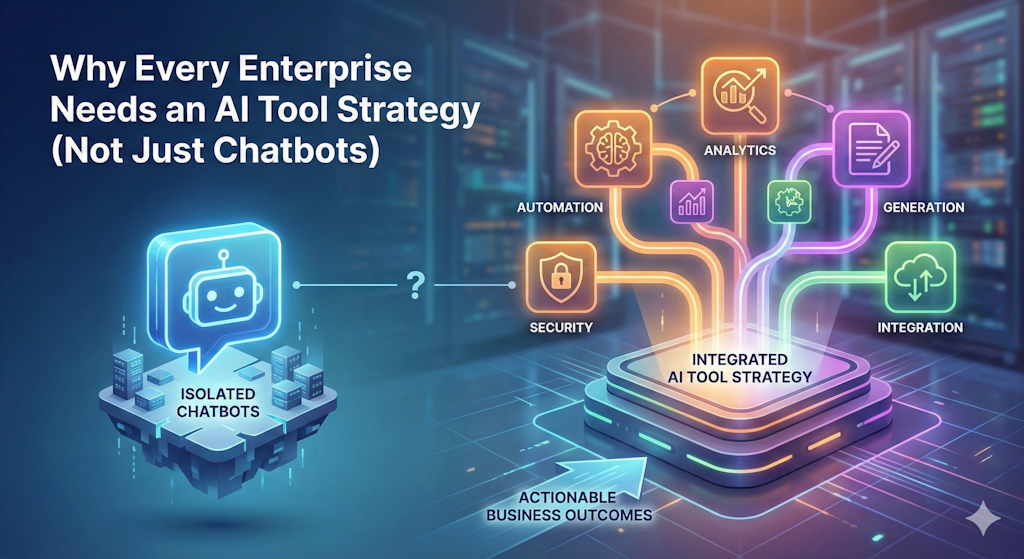
Let me tell you something that most vendors selling you “AI transformation” won’t say out loud: deploying a chatbot on top of your knowledge base and calling it an AI strategy is roughly equivalent to buying a calculator and calling it a data strategy.
I’ve spent three decades in enterprise IT. Data warehouses, ETL pipelines, Teradata, Snowflake, Databricks, Oracle, SQL Server. I’ve seen CIOs who built massive data lakes and then wondered why nobody was using them. I’ve watched enterprises spend tens of millions building “self-service analytics” portals that 97% of employees never opened. And now I’m watching history repeat itself with AI.
McKinsey’s State of AI 2025 report found that 88% of companies now use AI regularly in at least one business function. That sounds impressive until you read the next line: only 23% are actually scaling an agentic AI system. The other 65% are largely running chatbots. Fancy ones, sure. ChatGPT-powered, Claude-backed, Copilot-wrapped. But chatbots.
The question worth asking isn’t “do we have AI?” It’s “what can our AI actually do?”
The Chatbot Ceiling
Here’s what a standard enterprise chatbot deployment looks like in practice. You connect it to your SharePoint, your Confluence, maybe your product documentation. Employees can ask questions. It retrieves and summarizes. Sometimes it’s useful, sometimes it hallucinates, always it’s read-only.
That last part is the critical constraint. Read-only.
A chatbot can tell your IT support analyst what the SLA policy says for a P2 incident. It cannot look up the actual ticket, check the current status, see which engineer has been assigned, compare that against their workload in your project management system, and then update the ticket and send a summary to the relevant Slack channel. It cannot do any of that. It can only tell you what documents say.
This is not a language model problem. The LLMs powering these chatbots are genuinely capable. The problem is architectural. You’ve given the AI a brain but no hands.
Gartner has been tracking what they’re calling “agent washing” in the market. Vendors are rebranding existing chatbots and basic generative AI assistants as “agents” without delivering materially different capabilities. The market hype is running ahead of reality, and enterprises are buying the hype. Gartner is predicting more than 40% of agentic AI projects will be canceled by end of 2027, not because the technology doesn’t work, but because organizations misapplied it, couldn’t measure its value, or deployed without adequate risk controls.
That’s not a technology failure. That’s a strategy failure. And the strategy failure starts with not asking the right question.
The Right Question: What Tools Does Your AI Have?
Think about how your best employees operate. A senior analyst doesn’t just answer questions from memory. They query Salesforce for pipeline data, pull a report from your data warehouse, check the finance system for budget actuals, cross-reference against the project tracker, and synthesize it into a recommendation. The value isn’t in any single data source. It’s in the synthesis across systems.
Now ask: can your AI do that?
If your enterprise AI deployment cannot touch your actual systems, it is not doing what your best employees do. It’s doing a pale imitation. This is the chatbot ceiling.
The shift to agentic AI is fundamentally a shift from “ask AI questions” to “let AI take actions.” And actions require tools. This is why the conversation every enterprise needs to have right now isn’t about which AI vendor to choose. It’s about building a deliberate enterprise AI tool strategy: what systems will your AI agents be able to access, in what ways, under what conditions, with what guardrails?
I’ve been in enough architectural reviews to know that question rarely gets asked early enough. By the time people are ready to move from chatbot to agent, they’re discovering that half their critical systems don’t have APIs, the other half have APIs that were built for synchronous human workflows and will fall over under automated load, and nobody has thought through the security model at all.
What It Actually Looks Like When It Works
Let me make this concrete because “AI agents with tool access” sounds abstract until you see what it enables.
Imagine your IT operations team. They’re managing a service desk that handles roughly 2,000 tickets per month. Routine stuff. Password resets, access requests, software installation, VPN issues.
Here’s what an AI agent with a proper tool strategy can do with that scenario:
When a new ticket comes in, the agent queries ServiceNow to read the ticket details and classification. It checks your Active Directory or Okta integration to confirm the user’s department and existing access levels. If it’s an access request, it looks up your role-based access control policies, checks whether this user’s role entitles them to the requested access, and if it’s a clear yes, it can provision the access, update the ticket, notify the user via email or Slack, and log every action with a full audit trail. The whole cycle takes two minutes instead of two days.
Or consider a sales intelligence scenario. A rep is preparing for a call with a strategic account. An AI agent queries your Salesforce instance for the account’s deal history, open opportunities, and any recent support tickets from that company in ServiceNow. It pulls the account’s usage data from your Snowflake warehouse. It checks the rep’s notes from prior meetings in your CRM. It synthesizes this into a pre-call brief that actually contains institutional knowledge, not generic talking points. The rep walks in prepared.
Neither of these is science fiction. Both are happening at companies that have taken tool strategy seriously. Microsoft’s Copilot now has documented integrations with SAP, ServiceNow, and Salesforce using exactly this kind of agentic pattern. ServiceNow’s own AI agents operate on their unified data model across IT, HR, and operations workflows. The technology infrastructure for this exists today.
What’s missing in most enterprises is the deliberate architectural strategy to enable it safely.
MCP: The Infrastructure Shift That Changes Everything
MCP was introduced by Anthropic in November 2024 and has become something close to a standard at remarkable speed. By April 2025, the SDK had over 8 million downloads. OpenAI adopted it in March 2025. Google, Microsoft, and AWS followed. In December 2025, governance of MCP was transferred to the Agentic AI Foundation under the Linux Foundation, making it vendor-neutral.
The reason MCP matters is that it solves the integration problem at the infrastructure layer. Before MCP, if you wanted to connect an AI agent to GitHub, Slack, your Postgres database, and your ServiceNow instance, you were writing four custom integrations and maintaining them forever. MCP standardizes the connection protocol so that each tool exposes a server and each AI application connects as a client. One standard, any combination of tools.
The analogy that keeps getting used, and it’s accurate, is USB-C. Before USB-C, you had to have the right cable for the right device. After USB-C, you just plug in. MCP is doing for AI tool connections what USB-C did for charging cables.
What this means for enterprise architects is significant. Snowflake already has a managed MCP server. The pattern is: your AI agent connects to Snowflake’s MCP server, authenticates, and can now issue queries against your data warehouse. Same for GitHub, for Slack, for the growing ecosystem of enterprise tools publishing MCP servers.
But here’s where the architect’s caution is warranted. MCP is powerful precisely because it gives AI direct access to systems. And that power has already produced real security incidents. Microsoft 365 Copilot had a vulnerability (CVE-2025-32711) where hidden prompts could exfiltrate sensitive data. Asana’s MCP implementation had a bug causing data exposure across different customer instances. The mcp-remote package, with over 437,000 downloads, was vulnerable to remote code execution.
These aren’t reasons to avoid MCP. They’re reasons to approach it with the same rigor you’d apply to any enterprise integration. Which means security architecture has to be part of the tool strategy conversation from day one, not a follow-on concern.
The Governance Questions Nobody Is Asking Early Enough
I’ve built data architectures for companies for about 30 years now. One thing you learn fast is that data access without governance is not a feature, it’s a liability.
The same lesson applies to AI tool access, and most enterprises are not applying it. They’re either so restrictive that their AI agents can’t do anything useful, or they’re so permissive that an AI agent can theoretically query your entire Snowflake warehouse, including tables containing PII, compensation data, or information that some employees absolutely should not see.
The governance framework for enterprise AI tool strategy needs to address at least four dimensions:
Access scope. Which tools can the AI agent connect to? Within each tool, what can it read and what can it write? Can it query your data warehouse, or only specific schemas? Can it read Salesforce opportunities but not update them? Can it create ServiceNow tickets but not close them? These are role-based access control questions, and they need the same rigor you’d apply to a human employee getting system access. The principle of least privilege does not go out the window because you’re granting access to an AI.
Data classification. When an AI agent queries your data warehouse, it may retrieve results containing PII, HIPAA-covered health information, financial data that’s material under SEC regulations, or proprietary information covered by NDAs. Your existing data classification policies need to extend to AI agent interactions. Does your AI know it’s handling PHI? Does the framework prevent it from logging that data, caching it, or summarizing it in a channel that the wrong people might read?
Audit and accountability. If an AI agent updates a ServiceNow ticket, changes a record in Salesforce, or triggers a workflow in your ERP system, who is accountable? The answer in most organizations right now is “unclear,” which is not an acceptable answer in a regulated environment or when something goes wrong. Every action taken by an AI agent needs to be logged with sufficient detail to reconstruct what happened, why the agent took that action, what data it was operating on, and who authorized the agent’s deployment in the first place. This is not optional for enterprises in regulated industries. It is table stakes.
Human-in-the-loop thresholds. Some actions should require human confirmation before execution. Provisioning access to a sensitive system. Sending external-facing communications. Modifying financial records. Closing a high-value sales opportunity. Your tool strategy needs to define what the thresholds are and build the interruption mechanisms into the agent architecture before deployment, not as a patch afterward.
I have watched organizations skip these governance steps because they were excited about the technology and wanted to move fast. Without exception, they either got burned or they had to pull back and rebuild with governance layers retrofitted in. Retrofitting is always more expensive than building it right the first time. This is true in data architecture and it’s true here.
Legacy Systems: The Honest Conversation
Here’s something the vendor pitches don’t dwell on: a significant portion of enterprise data and processes lives in systems that were not designed for the kind of API access that AI agents need.
Your AI tool strategy has to be honest about what your systems can actually support. That means a realistic inventory: which systems have modern APIs suitable for agent integration? Which have APIs that exist but need rate limiting and careful access patterns? Which have no API at all and require a different approach, whether that’s reading from replicas, building an abstraction layer, or accepting that some systems will be out of scope for now?
This isn’t a reason to delay. It’s a reason to sequence intelligently. Start with the systems where API access is well-established and the security model is clear. Snowflake has excellent API infrastructure. Salesforce’s API is mature. ServiceNow’s integration capabilities are robust. These are reasonable starting points for building your first agentic workflows. Your 25-year-old COBOL-adjacent system feeding your general ledger is not where you start.
Why Gartner’s Warning Is Actually Useful
The statistic that 40% of agentic AI projects will be canceled by 2027 is not a reason for pessimism. It’s a warning about the conditions under which projects fail.
Gartner is clear about the failure modes. Projects stall when they’re driven by hype rather than specific business outcomes. They fail when cost models weren’t understood up front. They get canceled when risk controls were inadequate and something went wrong that eroded organizational confidence. And critically, they fail when the disconnect between a narrow, clean pilot and the messy complexity of production environments is too large to bridge.
Every one of these failure modes is addressable with the right strategy. Which brings me to what I think is the most important framing for enterprise leaders thinking about this.
Your AI tool strategy is your risk management framework for agentic AI. The enterprises that are actually scaling agents right now are not the ones that moved the fastest. They’re the ones that invested in defining clear access policies, building genuine audit trails, starting with measurable use cases, and treating agent deployment with the same governance discipline they’d apply to any other system integration.
This is not a novel concept for anyone who has run enterprise data programs. The organizations with mature data governance don’t have fewer use cases than the ones that never invested in governance. They have more. Because they built the foundation that makes new use cases possible without requiring a full security review from scratch every time.
The same dynamic will play out with AI tool access. The enterprises that invest now in defining their tool catalog, their access policies, their audit requirements, and their escalation thresholds will be the ones that can move quickly and safely when the next wave of agent capabilities arrives. The ones that skip this work will be the 40%.
Where to Actually Start
I’m not going to give you a numbered list. But I will share the architectural principle that I think matters most right now.
Treat your enterprise tool catalog the way you treat your data catalog.
In mature data organizations, you know what data assets you have, who owns them, what classification they carry, who has access, and what the access policies are. That catalog is a living document that enables governance without becoming a blocker to legitimate use.
Apply the same thinking to tools. What systems does your organization run? Which of those systems have API access that an AI agent could use? For each one, what actions should be permitted, what actions should require approval, and what actions should be prohibited entirely? Who owns the governance of each integration? What does the audit trail look like?
When you have that catalog and those policies, you have the foundation for deploying AI agents at scale. Without it, you’re building on sand, and you’ll discover that the hard way when an agent does something unexpected and nobody can explain why or prevent it from happening again.
This is architectural thinking applied to a new domain. It’s the same discipline that separates an organization with a real data strategy from one that just has a data lake full of files nobody trusts. The question has always been about governance, access, and accountability. The AI layer makes it more urgent, not different.
The Architect’s View
I’ve been thinking about this problem for two years, and I keep coming back to the same conclusion. The enterprises that will get the most value from AI agents are not the ones with the most sophisticated models or the biggest vendor contracts. They’re the ones that treat AI tool access as a first-class architectural concern and build the governance infrastructure to support it.
The question “what AI should we use?” is the wrong starting question. The right questions are: What should our AI be able to do? What systems should it have access to? Under what conditions? With what oversight? And what does accountability look like when something goes wrong?
Those are architecture questions. They require people who understand both the technical systems and the business constraints. They require the kind of institutional knowledge that comes from actually having worked with these systems, not just having heard about them in a vendor briefing.
The enterprises that answer those questions carefully will build something durable. The ones that deploy chatbots, call it AI transformation, and declare victory will be having a very different conversation in 18 months when they’re trying to explain to the board why they spent millions and changed nothing fundamental about how work actually gets done.
This is the data strategy question of 2026. Treat it accordingly.