
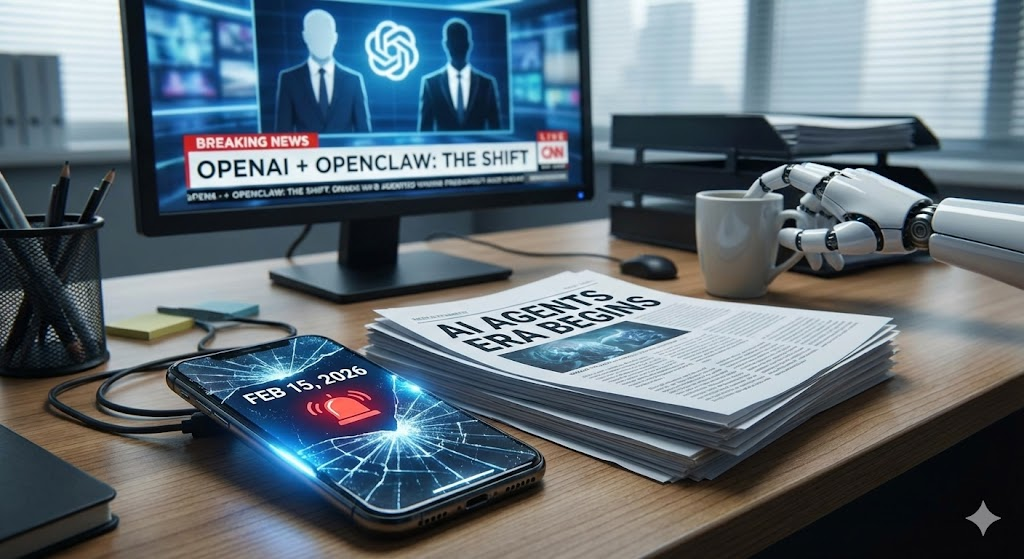
The wake-up call nobody saw coming just landed. And if you’re not paying attention, you’re already behind.
On February 15th, 2026, Sam Altman dropped a bombshell that should make every professional sit up and take notice. Peter Steinberger, the genius behind OpenClaw (the viral AI agent that does your work for you), just joined OpenAI to “drive the next generation of personal agents.”
This isn’t just another tech acquisition. This is the moment we’ll look back on as the inflection point. The moment AI stopped being a chatbot and became your coworker. Your assistant. Your replacement.
Let me be blunt: if you’re not learning AI skills right now, you’re gambling with your career. And the house always wins.
What Just Happened (The Facts You Need to Know)
Here’s what went down:
February 15, 2026: Sam Altman announces that Peter Steinberger, the Austrian developer who created OpenClaw, is joining OpenAI. But this isn’t an acquisition. It’s an “acqui-hire.” OpenAI hired the brilliant mind, not the company.
The promise: OpenClaw will remain open-source under a foundation that OpenAI will support. Translation: the tool that can book your flights, manage your calendar, respond to emails, and handle insurance claims autonomously is staying free and accessible.
The timeline: OpenClaw launched in November 2025. Within months, it hit 100,000+ GitHub stars and attracted 2 million visitors in a single week. It went from zero to essential faster than any AI tool in history.
The drama: The tool originally launched as “Clawdbot” (named after Claude). Anthropic threatened legal action. Peter Steinberger renamed it to “Moltbot,” and then finally “OpenClaw.” Three high-profile name changes in less than a month. That’s how fast things are moving.
And here’s the part that should terrify Anthropic: while they were busy banning users who connected Claude to OpenClaw (yes, they actually banned paying customers for using their API creatively), OpenAI was courting the creator and planning the future.
What Is OpenClaw? (And Why It Changes Everything)
If you haven’t heard of OpenClaw yet, let me explain what you’re missing.
OpenClaw is an AI agent. Not a chatbot. Not an assistant you have to babysit. A fully autonomous agent that actually completes tasks for you.
Here’s what that means in practice:
- Books flights for you automatically
- Manages your calendar without you touching it
- Responds to routine emails in your style
- Handles insurance claims end to end
- Checks you in for flights 24 hours before departure
- Schedules meetings by negotiating with other people’s agents
Think about that last one. Agent-to-agent interaction. Your AI talking to someone else’s AI to find a meeting time. No back-and-forth. No “does Thursday work?” It just happens.
This is the computer use paradigm. OpenClaw doesn’t just give you answers. It has hands! It takes actions. It clicks buttons. It fills out forms. It navigates websites. It does the boring, repetitive work that eats up 40% of your workday.
And it does it better, faster, and without complaining.
The Anthropic Drama: A Masterclass in How NOT to Handle Disruption
While OpenAI was making chess moves, Anthropic was playing checkers.
Here’s what happened:
- Users discovered that Claude (Anthropic’s AI model) worked brilliantly with OpenClaw
- Anthropic’s Claude Opus 4.6, released in early February 2026, became the preferred model for agent tasks
- Users started connecting their Claude API accounts to OpenClaw
- Anthropic responded by… banning them
Let that sink in. People paying $200/month for Claude Pro Max subscriptions were banned for using the product creatively. For automating their work. For doing exactly what AI is supposed to help you do.
The backlash was swift and brutal. The AI community turned on Anthropic overnight. Posts calling it the “ultimate ego moment” went viral. The narrative shifted from “Anthropic makes the best models” to “Anthropic is afraid of the future.”
Meanwhile, OpenAI swooped in and hired the OpenClaw creator. They embraced the open-source community. They signaled that they’re building the future, not fighting it.
The lesson:
In technology, you either disrupt yourself or someone else does it for you. Anthropic chose door number two.
The Numbers Don’t Lie: AI Is Coming for Your Job

Let’s talk about what this actually means for your career. Not in some distant future. Right now.
According to McKinsey’s latest research:
- 57% of U.S. work hours could be automated with current AI and robotics technology
- 14% of the global workforce will need to change careers by 2030
- 7% of U.S. jobs are already technically automatable today
Goldman Sachs estimates that 300 million jobs globally will be impacted by AI. Not in 20 years. By 2028.
MIT and Boston University project that 2 million manufacturing workers will be replaced by AI by 2026. That’s this year.
Gartner reports that 37% of business leaders plan to replace workers with AI by the end of 2026. And 20% of large organizations will use AI to eliminate over half of their middle management positions.
Read those numbers again. This isn’t speculation. This is data from the most credible research institutions in the world.
But here’s what those statistics don’t tell you: This isn’t about robots taking your job. It’s about someone who knows how to use AI taking your job.
The Great Divide: Those Who Learn and Those Who Don’t
We’re witnessing the formation of a new economic divide.
On one side: professionals who understand AI, who use tools like ChatGPT, Claude, and OpenClaw daily, who automate their repetitive work and focus on high-value creative tasks.
On the other side: those who resist, who “don’t trust AI,” who think their job is too complex to automate.
Guess which side is hiring? Guess which side is getting promoted? Guess which side will still have a job in 2028?
Here’s the brutal truth: Your company doesn’t care if you’re good at your job. They care if you’re the most cost-effective solution to a problem. The moment an AI agent can do 80% of your work at 5% of your salary, you become a liability.
Unless you evolve.
The OpenClaw Effect: What Comes Next
Peter Steinberger joining OpenAI isn’t just a hiring announcement. It’s a declaration of war on repetitive work.
Here’s what’s likely coming (based on industry trends and OpenAI’s track record):
Phase 1 (Next 2-4 months): OpenAI releases ChatGPT models specifically optimized for computer use and agent tasks. Longer memory. Better visual understanding of interfaces. Improved action planning.
Phase 2 (Summer 2026): OpenClaw Corporate Edition launches. Enterprise-grade agents with security, compliance, and audit logging. Companies pilot these in customer service, data entry, and administrative roles. Imagine when corporations have hundreds of OpenClaw agents witting in their computers ready to do coding, handling calls, debugging system issues, creating apps, doing database administration, system administration and …. you can imagine. What happens to the jobs for those tasks?
Phase 3 (Late 2026-Early 2027): Mass adoption. The early movers who deployed agents gain massive productivity advantages. Their competitors scramble to catch up. The job market shifts dramatically.
Phase 4 (2027-2028): Agent economy emerges. AI agents have their own cryptocurrency wallets. They interact with each other autonomously. The definition of “knowledge work” fundamentally changes.
This isn’t science fiction. Every piece of this is technically feasible today. The infrastructure exists. The models are capable. The only question is deployment speed.
And if there’s one thing we’ve learned from the AI revolution, it’s that things happen faster than anyone predicts.
Why This Is Your Wake-Up Call
If you’re reading this and feeling a knot in your stomach, good. That’s your survival instinct kicking in.
The professionals who thrive in the next five years won’t be the ones with the most degrees or the most experience. They’ll be the ones who learned to leverage AI to 10X their productivity.
Think about what that means:
- A marketer who uses AI agents to research competitors, draft campaigns, and analyze data can do the work of an entire team
- A developer who uses AI coding assistants can ship features 5x faster than peers
- A consultant who automates research and report writing can serve 10 clients instead of 3
- An entrepreneur who uses AI for email, scheduling, and customer service can scale without hiring
This is the new baseline. Not an unfair advantage. The minimum requirement to compete.
And here’s the terrifying part: most people aren’t learning. They’re waiting. Watching. Thinking they have time.
They don’t.
What You Should Do RIGHT NOW
Let's cut through the noise.
If you're reading this, you probably already use ChatGPT or Claude. You've played with prompts. You've seen the demos. That's not the question anymore.
The question is: are you building systems, or are you still running experiments?
Because the gap that's forming right now isn't between people who use AI and people who don't. It's between people who have integrated AI into their strategic workflow and people who open ChatGPT when they remember to.
Think about what just happened. OpenAI didn't acquire a chatbot. They acquired the vision behind an autonomous agent. One that books your flights, handles your insurance claims, manages your calendar, and negotiates on your behalf. While you sleep.
This is not a productivity hack. This is a structural shift in how value gets created.
Here's what separates professionals who will thrive from those who will scramble:
1. They understand AI architecturally, not just conversationally. Knowing how to write a good prompt is table stakes. Understanding how agents chain tasks, how models differ in reasoning vs. execution, how to orchestrate AI across your workflow. That's where the leverage is.
2. They treat AI adoption as a professional discipline, not a hobby. The same way you once committed to learning SQL, or cloud architecture, or data modeling. AI fluency requires structured investment. Not weekend tinkering.
3. They are positioning themselves as the bridge. Every organization needs people who can translate between what AI can do and what the business needs done. That role goes to the person with real depth.
4. They are building now, not benchmarking. While others debate which model is better, they're shipping automations, training their teams, and compounding their advantage every single week.
The professionals I work with in my AI Foundations for 10X Productivity course in association with KGF Bharat team aren't beginners looking for tips. They're experienced professionals. Data architects, project managers, consultants, business owners. People with 10, 20, 30 years of domain expertise who recognize that AI is the multiplier that makes all of that experience exponentially more valuable.
And that's the real insight here. AI doesn't replace expertise. It amplifies it. But only if you know how to wield it.
The OpenAI-OpenClaw Partnership Is Your Canary in the Coal Mine
Sam Altman didn’t hire Peter Steinberger on a whim. OpenAI has a $100+ billion valuation. They have access to every AI researcher on the planet. They chose the creator of an open-source agent tool that went viral in three months.
That tells you everything you need to know about where OpenAI is placing its bets. Autonomous agents. Computer use. AI that doesn’t just chat, but acts.
And when the richest, most powerful AI company on Earth makes that bet, you should probably pay attention.
Anthropic learned this the hard way. They had the best model for agents (Claude Opus 4.6). They had passionate users building incredible things. They could have owned this space.
Instead, they banned their most innovative customers and handed the future to their biggest competitor.
Don’t make the same mistake in your career.
Don’t ban yourself from the future by refusing to learn. Don’t hand your job to someone who spent 4 weeks mastering AI while you spent 4 weeks waiting.